

Active Aero Wheel
General information, design studies, technology demonstrations and much more about the Active Aero Wheel.

Active Aero Wheel (AAW)
Conflicting Objectives, Solution and Business Case


Venturo
Technology Demonstration on Public Roads

Wheel Concepts
Wheel Assembly Rethought

Curve Actuator AAW
Robust Design for Demanding Road Use
Active Aero Wheel
Why should wheels be closed? Why are they open?
And how does the Active Aero Wheel resolve this conflict?

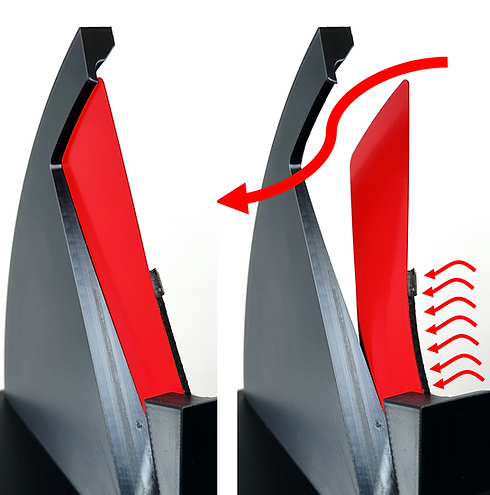
Standard:
Closed Wheel
On demand:
Open Ventilation
Active Aero Wheel – Aerodynamics Meets Intelligent Brake Cooling
The automotive industry faces a central challenge: on the one hand, aerodynamic drag must be reduced in order to lower energy consumption and, consequently, CO₂ emissions or the battery requirements of electric vehicles. On the other hand, sufficient brake cooling must be ensured to maintain full braking performance and safety.
With CompActive’s Active Aero Wheel, we resolve this conflict. Our innovative wheel concept significantly reduces aerodynamic drag while still providing demand-based brake cooling – exactly when it is needed. Based on an intelligent, purely material-based solution that requires no electronics and no complex mechanics, we offer a particularly robust and low-maintenance technology for modern vehicles.
Maximum Efficiency Through Reduced Air Turbulence
Aerodynamics plays a decisive role in vehicle energy efficiency. The Active Aero Wheel is an innovative development that switches between an open and a closed wheel design depending on demand.
While conventional wheels are either permanently open or largely closed, our system combines the best of both worlds:
✔ In its closed state, it reduces aerodynamic drag by up to 10 %, improving the range of electric vehicles or lowering the fuel consumption of combustion-engine vehicles.
✔ When required, the system opens and provides optimal brake cooling – but only when it is actually needed.
This adaptive technology reduces energy consumption and enables battery capacity to be used more efficiently. For example, a 5 % reduction in aerodynamic drag compared with partly closed wheels can allow the battery pack of an electric vehicle to be dimensioned smaller without sacrificing range. This not only reduces cost, but also saves weight and installation space.
Active Wheel. Flexible Cost Structure.
The Active Aero Wheel does not necessarily have to be considered an additional cost item. What matters is the evaluation of the complete wheel system. The closed, functional wheel surface creates additional design flexibility: design and functional elements can be shifted from expensive aluminium structures to more cost-efficient cover or plastic components. At the same time, surface finishing, wheel complexity, variant management and the assembly concept can be reconsidered.
As a result, the wheel becomes not only aerodynamically active, but also economically more flexible. The business case is therefore not created at component level alone, but through an integrated system design combining wheel, cover, actuation and assembly concept.
Business Case for the OEM and Real Customer Value
The Active Aero Wheel creates economic value exactly where it has the greatest impact for vehicle manufacturers: battery size, range and operating costs. By reducing energy demand, battery capacity can already be saved during vehicle development, or additional range can be achieved with the same battery. This creates a high instant return on investment (ROI) on the manufacturing cost side.
At the same time, customers benefit directly from a total cost of ownership (TCO) advantage: lower energy consumption, reduced operating costs and more usable efficiency in everyday driving. This makes the Active Aero Wheel not only a technical efficiency measure, but a clear value lever for OEMs, fleets and end customers.
As a scalable add-on technology, the system can be adapted to different platforms, vehicle classes and drivetrain concepts. In electric vehicles, the benefit is particularly strong through battery and range. In hybrid and combustion-engine vehicles, the technology supports consumption, CO₂ and efficiency targets.
✔ High instant ROI
✔ Lower TCO
✔ Technology for all drivetrains
Lean Cost Structure
Through a Smart Wheel Concept

The Active Aero Wheel reduces the vehicle’s energy demand and creates direct economic value: OEMs benefit from potential battery savings or additional range, while customers benefit from lower operating costs. A robust, scalable add-on technology with a clear business case – particularly strong for BEVs, but relevant for all drivetrains.

Venturo
Is the Active Aero Wheel already on the road?
What experience has been gained in real-world use?
The requirements are diverse.


Active Aero Wheel as a Demonstrator –
from wheel to the vehicle, onto the road
With Venturo, the Active Aero Wheel was integrated into a vehicle – and not only for test-track use. After successful testing and individual approval with TÜV Rheinland, the system is being operated on public roads.
In the hot brake test, it was demonstrated that the ventilation flaps open in response to temperature and that the targeted cooling of the brake system maintains the required braking performance.

Vent Flap Orientation
In this first version, the flap orientation was selected so that, when the brake is hot, a wide ventilation gap opens close to the outer circumference. The actuator tips point in a radial direction – from the centre outwards.
Static openings in the outer area are generally associated with a higher cooling effect, but also with a greater aerodynamic penalty. This position is particularly advantageous during heat soak, when the vehicle is parked with hot brakes, as the opening is located close to the outer diameter.
Integration Concept
To integrate the active flaps into the wheel, two existing mounting points in the series-production wheel were available. Prototype aluminium support frames are mounted at these points. In a series-production implementation, cost-efficient injection-moulded plastic frames could be used instead.


No Special Treatment
in Real Road Use
We validate the robustness promise of our technology with our demonstration vehicle. The Active Aero Wheel is deliberately exposed to uncompromising use, targeted stress scenarios and the everyday reality of road operation.
From brake testing to poor road surfaces, salt water and car washes: the system demonstrates that it can reliably withstand these requirements. Not just for a short functional test, but in continuous real-world vehicle use.
Current Status:
Data status: 27 July 2026
>13.000 km
Public road approval ✔
Brake fade tests with opening ✔
Long distance / highway 160 km/h ✔
Lateral acceleration ✔
Poor road conditions ✔
Curbstone edge ✔
Car wash ✔
High pressure water jet ✔
Salt water ✔
…and Efficiency?
We also examine efficiency in detail – even though robust conclusions are challenging without full-vehicle development expertise and our own capabilities remain limited. Through endurance testing and focused comparison drives, we make every effort to achieve the highest possible level of validity.
At the same time, this remains a sample result based on one specific baseline vehicle. The actual reduction in aerodynamic drag must ultimately be determined in professional wind tunnel testing.
We are happy to support OEMs with static models for aerodynamic wind tunnel measurements, as well as with active wheel inserts and wheel add-ons for testing in thermal wind tunnels.


mesured real-world
Consumption -6%
compared to original wheel


Original wheel
partly closed
Active Aero Wheel
fully closed
The investigation of potential savings and particulate matter reduction through active rim inserts is co-financed within the "InnoTop"-Programm by the EU and the state of Rhineland-Palatinate .


Wheel concpets

From Conventional Wheel to Active Aero Wheel: What Are the Options?
Examples and concepts showing how integration can be implemented.


Smart BORBET AE
An aftermarket wheel from our partner BORBET was used as the basis. The objective was to demonstrate how an aluminium wheel can be transformed into a closed and smart Active Aero Wheel without any additional components such as plastic frames.
With intelligent design and minor rear-side machining, active ventilation flaps can be mounted directly into the wheel. A particularly positive result: the wheel remains road-capable despite the post-processing.
Whether striking in red or refined in metallic silver, this creates an individual, novel appearance in addition to the efficiency gain.


Curve Actuator AAW
Harsh Boundary Conditions: What Makes the Curve Actuator So Robust? What are the key features of the version developed for the Active Aero Wheel?


Robust and Scalable
The Active Aero Wheel is based on an innovative, heat-activated technology that operates without electronics and without complex mechanics. This makes the system highly reliable and resistant to environmental influences.

Redundancy at Material and Component Level

No electronics
No mechanics
Technical Features
✔ One-piece functional solution without electronics – maintenance-free and durable
✔ Resistant to extreme conditions – withstands water, salt, dirt, ice and high acceleration loads
✔ High-quality materials – stainless steel 1.4310 for high stability and long-term durability
✔ Metal fixation and protective covers – for a robust and secure design
✔ Various mounting options – flexible integration into different wheel designs
This carefully engineered design makes the system durable and maintenance-free, even under the harshest operating conditions.
Highest heat resistance ✔
Integrated edge shields ✔
Corrosion-resistant materials ✔
Flexible mounting options ✔
Curve Actuator AAW as the Functional Backbone
With the actuator positioned in the background and corresponding visible plastic components on the outside, a clear separation is created between design-relevant parts and the functional backbone. This enables full design freedom on the visible side and cost-efficient assembly solutions on the rear side.
Whether the plastic frame carries only one actuator and covers a single spoke opening, or integrates several actuators and covers all spoke gaps in a wheel-cover-like design, can be considered as part of cost optimization for the overall wheel design.
The mounting interface can also be specifically designed according to the respective requirements.

Lean Minimum Solution with Rivets


Customer-facing surface
Functional backbone
Removable Standard Solution with Screws
Individual Design Options
There are virtually no limits to appearance and design – whether visible plastic components are used or the rear side of the actuator itself is coated accordingly and made visible.


From Concept to Series Production – Your Path to a Customized Aero Wheel
We offer a streamlined process to help you implement the Active Aero Wheel into your vehicle design.
Your Customized Solution in Four Easy Steps:
-
Select your wheel orientation and base design.
-
Define the opening geometry to optimize airflow.
-
Customize the look with premium coatings and engraved patterns.
-
Receive your tailored solution - from prototype to mass production.
Production & Delivery Times:
-
Proof of Concept (5 - 50 pieces): Delivered in under 4 weeks.
-
Pre-Series Testing (200 - 800 pieces): Delivered in under 10 weeks.
-
Series Production (>10,000 pieces): Start of production within ~12 months.
Thanks to our scalable manufacturing processes, we can meet all requirements—from small batches for concept vehicles to full-scale production.
Flexible Integration into different Rim Systems
Our system is designed for seamless integration into various vehicle configurations.
-
Direct Rim Integration – Minimal component count, all-metal design for maximum durability.
-
Integration via Inserts or Hubcaps – Allowing for additional design flexibility using customized plastic elements.
In collaboration with our industry partners, such as Borbet and mbDESIGN, we offer tailor-made solutions for complete rim systems at every stage — from the design study to series production — perfect for OEMs seeking an innovative, aerodynamic, and visually appealing solution.